

What is Elliott Wave Theory in Trading?
Elliott Wave Theory in trading is a powerful method that helps traders identify market trends and predict future price movements. It is based on market psychology, where prices move in repeating patterns known as waves.
In simple terms, Elliott Wave Theory in trading allows beginners to understand how the market behaves during both trending and corrective phases. By using this strategy, traders can make better decisions and improve their trading accuracy.
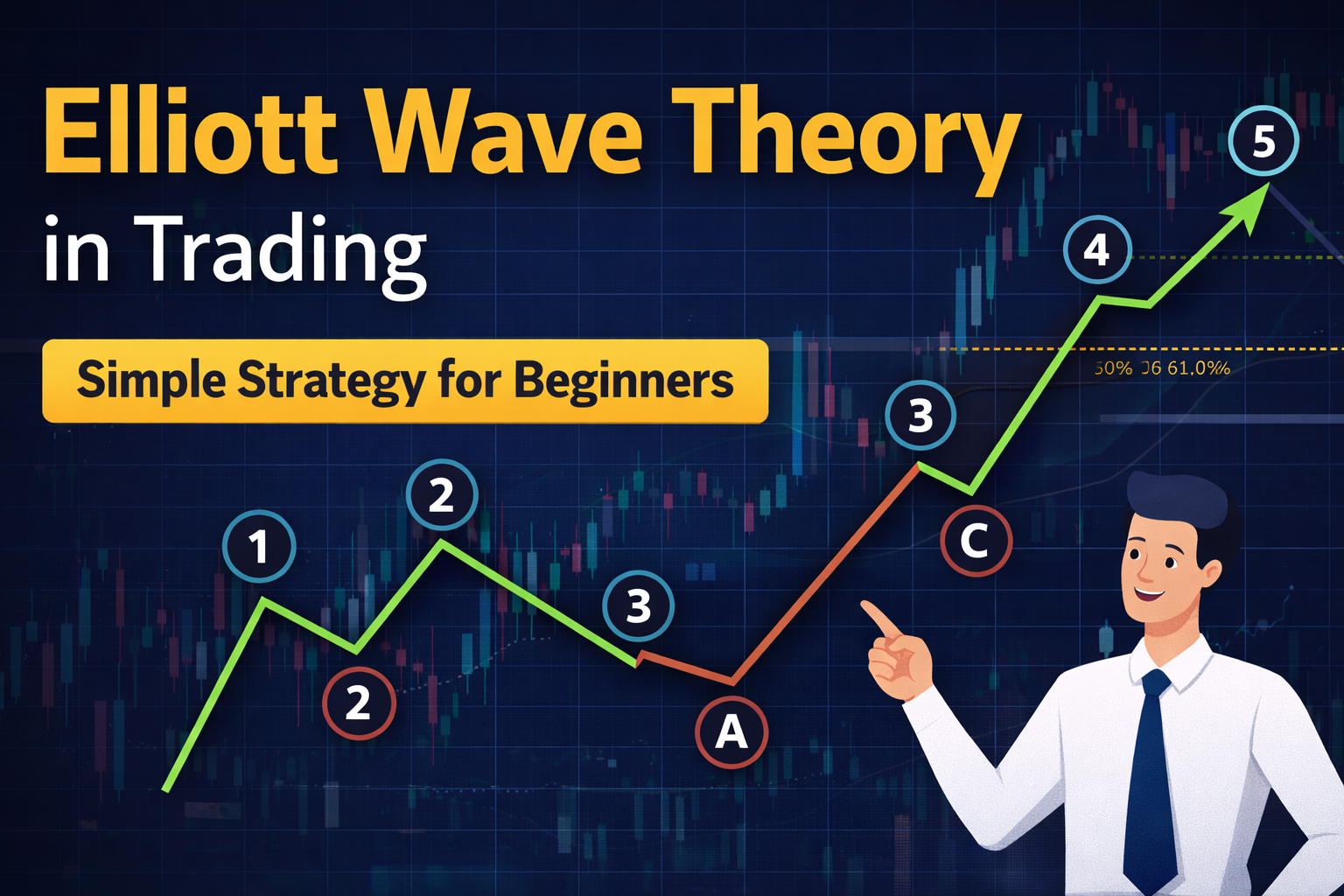
Elliott Wave Basic Structure Explained
Elliott wave theory in trading divides the market into two main types of waves:
- Impulse Waves (5 waves) → move in the direction of the trend
- Corrective Waves (3 waves) → move against the trend
This structure helps traders identify whether the market is trending or correcting.
Understanding Impulse Waves (5 Wave Structure)
Impulse waves follow a 5-wave pattern:
1 → 2 → 3 → 4 → 5
- Wave 1 starts the trend
- Wave 3 is the strongest and longest
- Wave 5 signals the end of the trend
In elliott wave theory in trading, wave 3 is usually the best opportunity to enter the market.
Understanding Corrective Waves (ABC Pattern)
Corrective waves move against the main trend and follow an ABC pattern:
- A = initial correction
- B = temporary pullback
- C = final move
These corrections help traders prepare for the next impulse move.
Key Elliott Wave Rules Every Trader Must Know
To correctly apply elliott wave theory in trading, you must follow these rules:
- Wave 2 cannot retrace more than 100% of Wave 1
- Wave 3 cannot be the shortest wave
- Wave 4 cannot overlap Wave 1
These rules ensure your wave count is valid.
Using Elliott Wave Theory in Trading for Trend Analysis
Elliott wave theory in trading helps identify the overall market trend:
- 5 waves = strong trend
- ABC pattern = correction or reversal
This makes it easier to decide whether to buy or sell.
Finding High-Probability Entry Zones
The best entry points in elliott wave theory in trading are:
- End of Wave 2
- End of Wave 4
These zones provide strong risk-to-reward opportunities.
Using Fibonacci with Elliott Wave Theory in Trading
Fibonacci levels improve accuracy in elliott wave theory in trading:
- Wave 2 → 50%–61.8% retracement
- Wave 3 → 1.618 extension
- Wave 4 → 38.2% retracement
This helps traders find precise entry and exit levels.
Trading Corrections with Elliott Wave
Corrections can also be traded using elliott wave theory in trading:
- Zigzag → strong correction
- Flat → sideways market
- Triangle → breakout setup
Understanding these patterns improves trade timing.
Combining Elliott Wave with Indicators
For better results, combine elliott wave theory in trading with:
- RSI → overbought/oversold
- MACD → trend confirmation
- EMA → trend direction
This increases accuracy and confidence.
Risk Management Using Elliott Wave Theory in Trading
Risk management is essential:
- Place stop loss at wave invalidation level
- Use minimum 1:2 risk-reward ratio
- Avoid overtrading
This protects your capital.
Real Example of Elliott Wave in Trading
In real market conditions, elliott wave theory in trading helps traders identify strong trends and corrections. For example, traders can enter at the end of wave 2 and target wave 3, which usually gives the highest profit potential.
Common Mistakes in Elliott Wave Trading
Avoid these mistakes:
- Forcing wave patterns
- Ignoring key rules
- Not using confirmation tools
These mistakes reduce accuracy.
Can Elliott Wave Predict Market Tops and Bottoms?
Yes, elliott wave theory in trading can help identify market tops and bottoms. Wave 5 and wave C often signal reversal zones, but confirmation is always required.
Best Elliott Wave Theory in Trading Strategy for Beginners
Simple strategy:
- Identify trend
- Count waves
- Use Fibonacci
- Enter at Wave 2 or 4
- Place stop loss correctly
This strategy is beginner-friendly and effective.
FAQs
Which waves are best for entering trades?
Wave 2 and Wave 4 are the best entry points.
How do Fibonacci levels help with Elliott Wave?
They help identify entry, exit, and target levels.
How can I manage risk using Elliott Wave?
Use stop loss at invalidation points and proper risk-reward ratio.
Should I use Elliott Wave alone or with other tools?
Always use it with indicators for confirmation.
You can also explore our professional trading courses to learn advanced strategies and improve your trading skills.
Learn more about our trading mentor and view real results in our portfolio to build trust and confidence.
Conclusion
Elliott wave theory in trading is a powerful tool that helps traders understand market trends, find entry points, and manage risk effectively. By combining this strategy with Fibonacci and indicators, traders can significantly improve their trading performance.